For medical and dental practices
Fuller schedules, fewer no-shows, patients who come back.
We set up AI for your practice and connect it to your scheduling system. It works every day on no-shows, empty chairs, recall visits and new patients, and it only ever sees counts and dollars, never patient names or charts. Then our AI keeps making it better, with a real person on a call every month.
Get a free 20-minute consultation. Tell us what matters most, then pick a time.
 You'll talk to our founder for 20 minutes, no sales pitch.
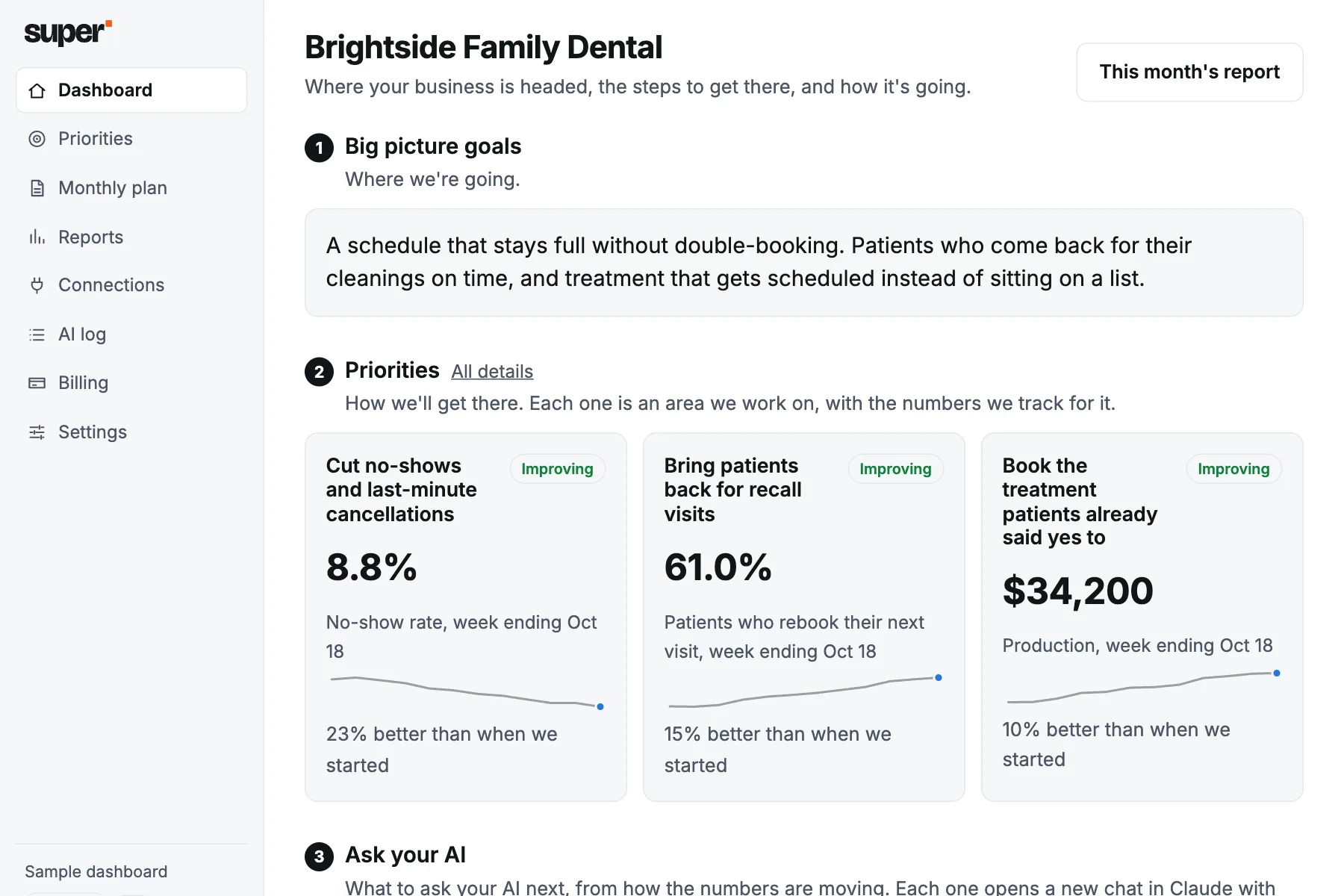 This is your dashboard: your priorities, and how each number has moved since you started. It's a sample for a made-up business. Open the live one
AI in medical and dental practices today
Most independent practices are not yet using AI on the front desk. The American Dental Association's own survey found dentists using it mostly for imaging and insurance checks, and the AMA finds physicians using it mostly for notes and research. The business side, meaning calls, reminders, recall and reviews, is where vendors are selling hardest and where the evidence is thinnest. The cautions are clearer than the numbers: patient information is the hard part, and patients still want a person when the call is about their health.
How it's being used
- More than four in ten dentists (43.3%) now use AI for at least one task, and another 26.4% plan to start. The most common uses are imaging (22.8%) and insurance verification (13.6%). Only 10.1% use it for reception or check-in, so the front desk is still early. ADA Health Policy Institute, HPI Perspectives, July 2026
- Among physicians, 81% say they use AI in their work, more than double the 2023 share. The top uses are summarizing research and writing notes, charts and care plans, and 19% use it to draft replies to patient portal messages. American Medical Association, 2026 Physician Survey on Augmented Intelligence (nearly 1,700 physicians), March 2026
- A dental AI phone-assistant company tracked one month of calls at a 26-practice group and found 62% of inbound calls were answered. Of answered calls, 40% ended in a booking: 25% for new patients and 56% for existing ones. The company says its assistant booked 144 appointments from calls staff missed. These are the vendor's own numbers. Peerlogic (vendor case study), 2026
- A dental software company that analyzed its own customers' practice data says no-show rates kept falling in 2025 and cancellations dropped 17%. It reads as a vendor's view of its own customer base, not a national survey. Planet DDS, 2026 Dental Industry Outlook (its own Denticon practice data), March 2026
- Patients read reviews before booking. In a survey of more than 1,000 U.S. patients, 84% check online reviews before choosing a new provider and 51% read at least six. Yet 57% rarely or never leave one for their own provider. rater8 (a reputation management company), reported by Medical Economics, February 2025
Where it's going wrong
- Staffing is the top worry. About 62% of dentists named staffing shortages as the biggest challenge for their practice in 2025. Hiring hygienists and assistants is the hardest, though the share calling it very or extremely hard has eased somewhat since 2022. ADA Health Policy Institute poll, reported by ADA News, February 2025
- Dentists hold back on anything clinical. Fewer than 5% use AI for treatment recommendations and 82.6% do not plan to. The worry is errors leading to overtreatment or misdiagnosis. ADA Health Policy Institute, HPI Perspectives, July 2026
- Privacy is the first concern for physicians: 86% said data privacy is critical before they will adopt AI more widely, and 85% want to be consulted on adoption decisions. American Medical Association, 2026 Physician Survey on Augmented Intelligence, March 2026
- A HIPAA compliance consultancy writing for the California Dental Association says dentists should never put patient data into the free public version of ChatGPT, should enter only the minimum necessary elsewhere, and should get a signed business associate agreement from any vendor that can access patient information, before using the product. This is a consultant's guidance, not a regulator's ruling. Abyde, published by the California Dental Association, August 2025
- The ADA told HHS that AI adoption is uneven among small and mid-sized practices because of upfront cost, workforce readiness and unclear rules. It also said unclear liability and privacy responsibilities leave practices unsure what vendors are accountable for. ADA, letter to HHS reported by ADA News, February 2026
- People want a human for health calls. In a survey of more than 2,000 U.S. adults, nearly a quarter of those who had dealt with AI on a health-related call gave up without the help they needed, and a solid majority wanted a person for test results and emergencies. The survey was run by an answering service company with an interest in human reception. Answering Service Care, reported by Medical Economics, September 2026
What we take from it
The line that matters is between patient information and practice numbers. Most of the caution above is about what happens when AI touches charts, images, notes or a caller's health question. We stay away from all of it. What your AI sends us is counts and dollars from your practice system, such as open hours, no-shows, patients overdue for recall and money owed. We never receive patient information, and it never gives clinical advice.
The business side is where the lost money is. Calls that go unanswered, hygiene patients who never rebook and a schedule with holes in it are all non-clinical. We work on them from the other end: reminder and reappointment messages, filling a cancelled slot, following up with a new patient who did not book, asking happy patients for a review, and chasing what is owed. You approve what goes out, and you get the weekly numbers so you can see whether it is moving.
The front desk is already short-handed, and patients still want a person on the phone for anything about their health. So we are not trying to replace your team or put a machine in front of your callers. We take the repeat follow-up work off your people so they have time for the patient standing at the counter. Whether you ever put AI on your phones is your decision.
Sources last checked October 2026. The summaries are ours; follow the links for the full reports.
What we connect to for medical and dental practices
You keep the tools you already use. Your AI connects to two of them with you before we meet, and more can be added.
Open Dental
Appointments, production, and collections, counts only.
Tebra
Practice visits and new patients, counts only.
Google Analytics, Business Profile, and Ads
Website visits and bookings, calls from your listing, and ad results.
Birdeye
Reviews across sites, and your replies.
QuickBooks Online
Revenue, expenses, profit, and who owes you money, every week.
Gmail
Drafts replies, follow-ups, and reminders for you to approve.
Use something else? See everything we connect to, or ask on the call.
How it works
One setup, then it keeps getting better. See each step in detail.
$1,000 a month for two priorities, plus setup from $1,500. See pricing · What we connect to
Common questions
Click a question to see the answer.
What about HIPAA and patient data?
We never receive patient information. What your AI sends us is counts and dollars from your practice system, such as no-shows, open hours and overdue recall totals, never names, charts, treatment details or photos. We do not claim HIPAA certification. Your AI runs on your own Claude account, so what you let it see is your decision and your responsibility, as with any other software you use.
Will it replace my front desk?
No. It takes on the follow-up work that tends to slip when the desk is busy: reminders, recall and reappointment messages, no-show follow-up, review requests and collections nudges. Your people still greet patients, answer the phone and handle anything that needs judgment.
What does it do about no-shows and recall?
It drafts reminders, offers open slots to people on your list when someone cancels, and follows up with patients who are overdue for hygiene so they rebook. You approve what goes out, and each week you see the numbers: no-shows, open hours and how many patients came back.
Does it handle insurance and billing?
It does not verify insurance or work claims. It can follow up on balances you already know are owed and show you the totals, such as collected and outstanding dollars. It never gives clinical advice and does not touch treatment plans.
What does it cost, and do I need to switch software?
$1,000 a month for two priorities, plus setup from $1,500. It is three months to start, then month to month. You do not need to switch software. We work with the practice, scheduling and accounting tools you already use, and the first step is a free 20-minute call.
Ready to talk?
Twenty minutes with our founder. Tell us about your business and see where AI can take it.
Ready to pick your first two? Tell us about your business on a free 20-minute call.
You'll talk to our founder for 20 minutes, no sales pitch.