For online stores
More orders. Fewer abandoned carts. Customers who come back.
We set up AI for your online store and connect it to the store, your email tool and your books. It follows up the carts that were left behind, brings first-time buyers back for a second order and keeps the best sellers in stock, so growing the store stops depending on your evenings. Then our AI keeps making it better, with a real person on a call every month.
Get a free 20-minute consultation. Tell us what matters most, then pick a time.
 You'll talk to our founder for 20 minutes, no sales pitch.
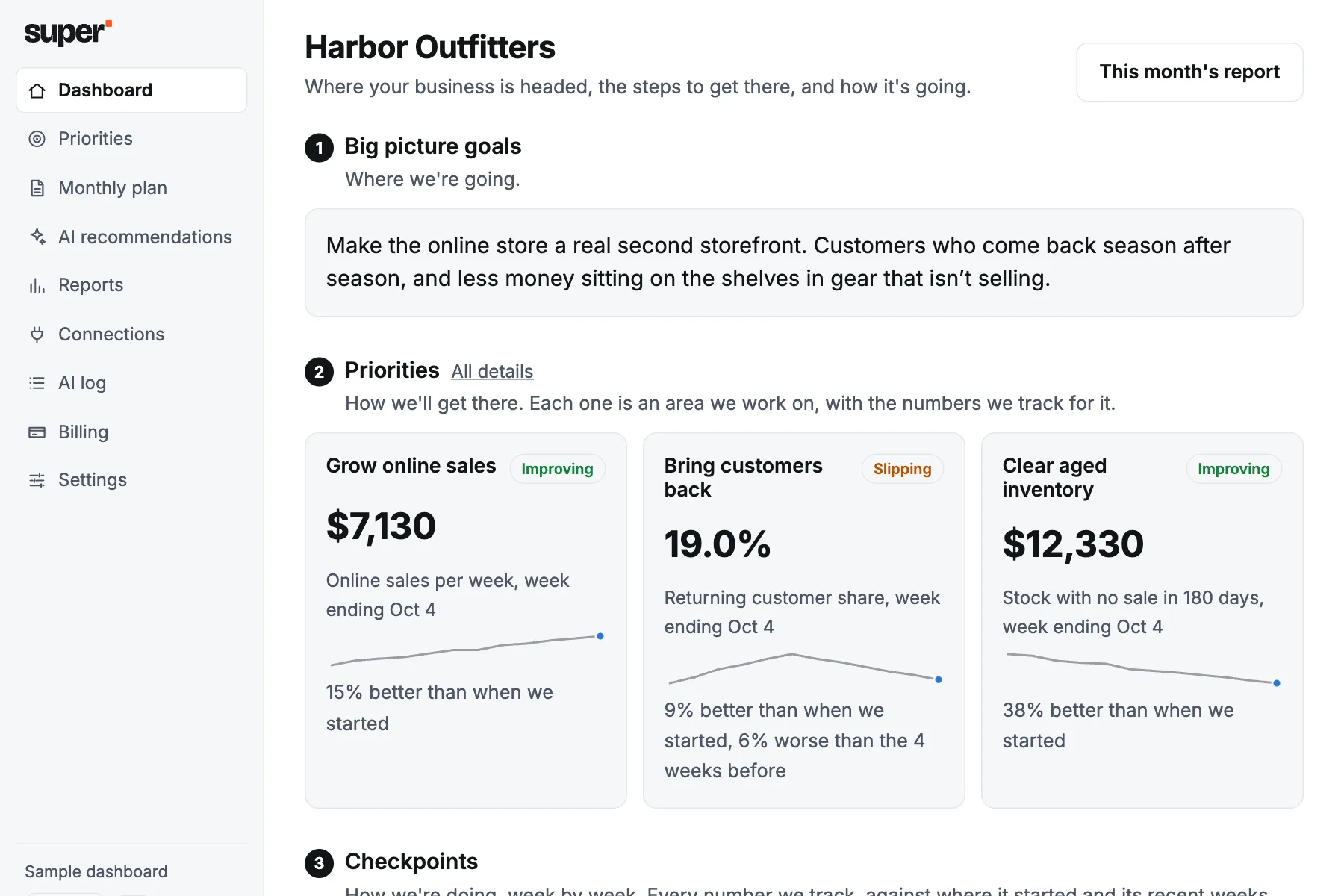 This is your dashboard: your priorities, and how each number has moved since you started. It's a sample for a made-up business. Open the live one
See a week of AI at an online store
A short video of what your AI would do.
AI in online stores today
Most independent online sellers now use AI, but the typical use is narrow: rewriting listings, making product images and answering routine questions. The official Census survey still shows retail as a below-average adopter, with use at the smallest firms flat. Meanwhile the buying side is moving fast: visits sent to stores by AI assistants are growing and converting well, and the platforms have made selling inside ChatGPT a default. The problems sit in the gap between the two. A quarter of sellers cannot point to a result yet, in-chat checkout flopped even for Walmart, AI assistants get facts wrong about small retailers more often than about big brands, and shoppers say visible AI marketing makes them trust a store less.
How it's being used
- Among sellers on online marketplaces, 83% use AI somewhere in the business, averaging about three uses each. The common ones are rewriting product listings (64%) and making product images and video (49%); pricing and inventory forecasting trail well behind, and sellers under $500K in revenue average fewer uses still. Marketplace Pulse, Seller Index, April 2026
- In a poll of about 1,000 small retailers that sell online, 71% regularly use AI tools and 52% use them daily, mostly ChatGPT, Gemini and Copilot. Asked what it had done for them, half said it automated repetitive tasks and 45% said it increased sales; 13% could name no benefit. The poll was sponsored by a technology industry group. TechNet, poll by Morning Consult, April 2026
- The Census Bureau puts AI use at about 20% of US businesses but only about 14% in retail, with another 17% of retailers expecting to start within six months. Use rose at firms with 20 or more employees and did not change significantly at smaller ones. US Census Bureau, Business Trends and Outlook Survey, May 2026
- Traffic sent to US retail sites by AI assistants was up 62% year over year in July 2026, and those visits converted 60% better than other traffic, the eleventh month in a row AI referrals out-converted the rest. These are Adobe's own analytics across the sites it measures, not a survey. Digital Commerce 360, on Adobe Analytics data, August 2026
- Shopify told investors that AI-referred traffic to its merchants' stores and orders from AI channels each tripled year over year in the second quarter of 2026, with no base numbers disclosed. Its Agentic Storefronts let even the smallest merchants sell through ChatGPT, Perplexity and Copilot. The figures are the platform's own. PYMNTS, on Shopify's earnings call, August 2026
Where it's going wrong
- In the same survey of marketplace sellers, the single most common answer on where AI had made a difference was that no area has delivered a measurable result yet, from a quarter of sellers. Use is broad; results are not. Marketplace Pulse, Seller Index, April 2026
- OpenAI wound down ChatGPT's Instant Checkout in March 2026 after people involved said it did not drive sales. Etsy saw little volume from it, and Walmart said conversion was three times lower for items bought inside the chatbot than when shoppers clicked through to its own site. People were researching in ChatGPT, not buying there. Modern Retail, March 2026
- A test that put more than 72,000 questions about UK retailers to ChatGPT, Gemini and Perplexity found at least one false fact about 64% of the businesses, most often the wrong address. The authors say the errors hit smaller businesses harder because they leave a thinner trail online for the AI to draw on. The study was run by a company that sells AI-visibility software. Retail Technology Innovation Hub, on a Searchable study, July 2026
- In a survey of about 1,200 merchants, only 15% had product data structured so an AI shopping agent could read it, and only 23% could tell AI-driven traffic from human traffic. Small and mid-sized merchants were more likely than large ones to see AI agents as a threat, fearing they steer shoppers to bigger, better-organised competitors. The research was commissioned by a payments company. PYMNTS Intelligence, for Visa Acceptance Solutions, July 2026
- In a UK shopper survey, 31% said visible AI-generated marketing makes them trust a brand less, 72% were concerned about AI product recommendations, and 63% said inconsistent product photos make a seller look unreliable. The survey was run by a company that sells AI image tools, and the sample size was not given. IT Brief UK, on a Photoroom survey, May 2026
What we take from it
Sellers have AI writing listings and making pictures, and a quarter of them cannot see what it changed. That is because listings are not where the money leaks. It leaks in the cart that was abandoned, the first-time buyer who never came back and the best seller that sold out on a Saturday. Those are arithmetic problems with your own order data, and they are where your AI starts.
The shoppers arriving from AI assistants convert better than anyone else, and the assistants get small stores wrong more often than big ones. The fix is unglamorous: product data that is complete and consistent, stock levels that are true, a Google profile and reviews that are current. Your AI keeps that housekeeping up every week so the assistants describe you correctly.
Shoppers punish AI they can see and reward a store that feels like a person runs it. So nothing AI-made goes in front of your customers unless you choose it. The emails, the replies and the product copy are drafted in your voice for you to approve, and we measure the result in orders and repeat buyers, not in posts.
Sources last checked October 2026. The summaries are ours; follow the links for the full reports.
What we connect to for online stores
You keep the tools you already use. Your AI connects to two of them with you before we meet, and more can be added.
Shopify
Orders, sales, repeat customers, and inventory.
WooCommerce
Orders and sales from your WordPress store.
Squarespace Commerce
Orders and sales from your Squarespace store.
Amazon Seller Central
Sales and orders from your Amazon storefront.
Klaviyo
Email and text campaigns and the revenue they drive.
QuickBooks Online
Revenue, expenses, profit, and who owes you money, every week.
Use something else? See everything we connect to, or ask on the call.
How it works
One setup, then it keeps getting better. See each step in detail.
$1,000 a month for two priorities, plus setup from $1,500. See pricing · What we connect to
Common questions
Click a question to see the answer.
Which store platforms do you work with?
Shopify, WooCommerce, Squarespace Commerce and Amazon Seller Central to start, plus the email tool and accounting you already use. If you sell on more than one, we connect the one that matters most on setup day and add the next later.
Is this an app I install?
No. Your AI runs on a Claude subscription in your name, connected to your store and your other tools. There is nothing added to your storefront and nothing your customers see.
Will it write my product pages?
Only if you want it to, and you approve every word. Its main work is behind the store: abandoned carts followed up, first-time buyers brought back, stock watched, and the weekly numbers in one place.
I also have a physical shop. Does that count?
Yes. We connect the point of sale as well, and the priorities menu for retail shops covers both. Many of our retail clients run one of each.
What does it cost?
$1,000 a month for two priorities, plus setup from $1,500. The first step is a free 20-minute call.
Ready to talk?
Twenty minutes with our founder. Tell us about your business and see where AI can take it.
Ready to pick your first two? Tell us about your business on a free 20-minute call.
You'll talk to our founder for 20 minutes, no sales pitch.